
Ebook by A K Gupta
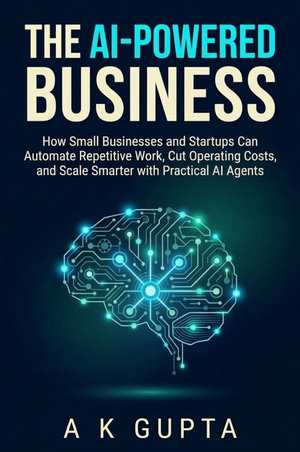
The AI-Powered Business
How Small Businesses and Startups Can Automate Repetitive Work, Cut Operating Costs, and Scale Smarter with Practical AI Agents.
For small and mid-sized business owners, founders, sales leaders, finance heads and agency owners who want fewer manual tasks and a clear plan.
Why this book
Access to AI is not the same as a better business
A company can buy several AI subscriptions and still struggle with inefficient processes. The real challenge is knowing what to automate, why, and how to measure whether it works.
This book takes a business-first approach: understand how the company actually runs, find where time and accuracy are lost, and only then choose the technology.
The goal is not to automate everything. It is to build a business that operates more intelligently.
Who it's for
- Small and medium-sized business owners
- Startup founders and operations teams
- Sales, marketing and finance leaders
- Agency owners stuck in manual follow-ups, invoicing, reporting and data entry
Part I
Ten chapters, one clear path
Each chapter ends with an action plan and a key takeaway you can use the same week.
The Hidden Cost of Repetitive Work
Why small, predictable tasks add up to major business expenses, and how to spot the ones worth automating first.
Your Roadmap to an AI-Powered Business
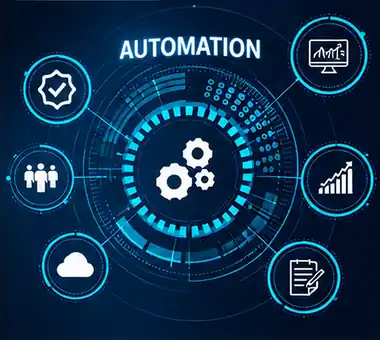
The six-stage Practical AI Deployment System: Discover, Prioritize, Design, Deploy, Monitor, Improve.
Choosing the Right AI Tools Without the Overwhelm
Match the technology to the business problem and use the simplest approach that reliably works.
Eliminating Manual Data Entry and Operational Errors
Turn emails, PDFs and forms into structured data, with validation rules and human review.
AI Agents That Transform Customer Support
Answer routine questions faster using approved company information, and escalate when unsure.
Automating Sales and Follow-Ups
Build a more consistent pipeline with better targeting, personalized outreach and reliable follow-up.
Connecting Your Disconnected Business Systems
Move information reliably between email, messaging, CRM and spreadsheets so teams stop re-typing it.
Deploying AI Without Breaking the Budget
Start small, understand total cost, calculate payback honestly and expand only on proven results.
Getting Your Team to Embrace AI
Treat AI adoption as a people-development project, not just a technology project.
Scaling Your Business with AI Agents
A six-month roadmap and the measures that separate genuine improvement from impressive demos.
The method
The Practical AI Deployment System
Discover, Prioritize, Design, Deploy, Monitor, Improve. Each stage has a purpose, a key question and a deliverable.
| Stage | Purpose | Key question | Deliverable |
|---|---|---|---|
| 1 Discover | Find the real problem | Where do time, accuracy and customers get lost? | Task audit |
| 2 Prioritize | Pick the best first project | Which option has high value with low risk and effort? | Scored shortlist |
| 3 Design | Plan how it will work | What starts it, what can AI decide, what must a human approve? | Workflow canvas |
| 4 Deploy | Prove it on a small scale | Does it work on real cases with real users? | Controlled pilot |
| 5 Monitor | Track results | Is it faster, more accurate and cost-effective? | Scorecard |
| 6 Improve | Refine and extend | What should we fix, extend or stop? | Next-step decision |
The human-in-the-loop rule
Every workflow gets one of three oversight levels. Start at level 1 and move up only when the scorecard shows reliable results. Contracts, pricing, legal and financial commitments always stay at level 1.
- 1. AI assists. AI drafts, a person decides and sends (proposals, customer emails).
- 2. AI acts, a person samples. AI performs low-risk steps and a person reviews a sample (CRM updates, tagging).
- 3. AI acts, exceptions escalate. AI handles routine cases and flags unusual ones (acknowledgments, scheduling).
Part II
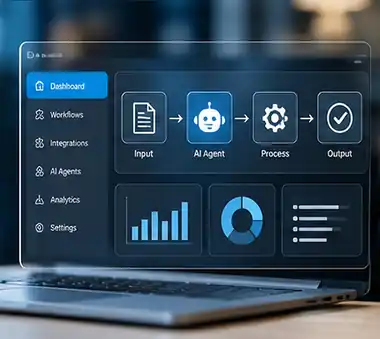
The Practical AI Automation Toolkit
Part I explains the system. Part II turns it into something you can run.
- 3
Case scenarios
The system applied end to end
- 6
Worksheets
Task audit, scoring, ROI, workflow canvas, pilot scorecard, expansion decision
- 5
Checklists
Pre-pilot, security and privacy, reliability, go-live, monthly review
- 30
Day action plan
From first audit to a measured automation and a clear decision
The 30-day plan, at a glance
- Week 1, Discover: audit repetitive tasks with your team.
- Week 2, Prioritize and Design: score options, choose one pilot, measure the baseline.
- Week 3, Deploy: build with validation and error alerts, then start a pilot with human review.
- Week 4, Monitor and Improve: track results, complete the scorecard and decide to scale, improve or stop.
Inside the toolkit
Three case scenarios
Illustrative composites from the book. Figures show the method, not promised results.
Illustrative · 6 employees
The growth agency with lost leads
Measure Before After pilot Median first reply 26 hours 2 hours Inquiries with no reply in 2 days 30% 4% Admin time on intake 8 hrs/week 2 hrs/week Lesson: The problem was follow-up reliability, not lead volume.
Illustrative · 14 employees
The distributor drowning in documents
Measure Before After pilot Entry errors about 5% under 1% after review Time per document 9 min 3 min Documents flagged for review n/a 12% Lesson: Validation and review, not extraction speed, created the value.
Illustrative · 3 employees
The consultancy with slow proposals
Measure Before After pilot Hours per proposal 5 2 Proposals sent within 48 hours 40% 90% Lesson: AI drafts, the human commits. Pricing and scope are never automated.
About the author
A K Gupta
A K Gupta is an engineering and AI automation professional with more than 12 years of experience in project delivery, operational processes, task management, data handling, reporting and process improvement.
The author focuses on helping startups and small and medium-sized businesses find repetitive activities, connect business applications, improve customer communication and deploy cost-effective automation, combining process analysis, AI models, workflow orchestration and human oversight.
The mission: make AI adoption understandable, accessible and valuable for businesses that want to grow smarter.
Work with me directly
Want the system applied to your business? Book a free AI Automation Audit and we'll identify which manual processes can be automated and estimate the time and cost savings.
Book a free AI Automation AuditFAQ
Common questions
Will AI replace my employees?
The system is designed to recover capacity from repetitive work so people can spend more time on relationships, judgment and growth. Be honest with your team about how roles will change.
Do I need to write code?
Not always. Many workflows can be built with visual automation platforms, though complex integrations may benefit from technical help.
What if the AI is wrong?
Plan for it. Use validation, approved knowledge sources, escalation and human review, and measure error rates rather than assuming accuracy.
How much should my first project cost?
Choose one whose total cost, including setup, subscriptions, usage and maintenance, you can recover within a reasonable period using the ROI worksheet.
Get The AI-Powered Business
Start with one measurable problem, prove the value, and scale gradually.
Download the ebookQuestions? Email us.
A note to readers. The examples, cost calculations and implementation timelines in the book are illustrative. Actual results depend on business requirements, data quality, technology choices, employee adoption, operating costs and implementation quality. The book provides a practical framework for evaluating and adopting AI and does not guarantee specific financial or operational outcomes.